The First Women's Olympic Marathon: Joan Benoit, Los Angeles 1984
The first women's Olympic marathon was run on August 5, 1984, in Los Angeles, with 50 women on the start line. Joan Benoit, who had knee surgery that spring, breaks away in the first kilometers and is never caught. Behind her, a Swiss runner writes another page, in tiny steps.
By the PacePoster desk · · 3 min · 13 sources

01Why the first women's Olympic marathon had to wait until 1984
Amsterdam, 1928: women are finally allowed Olympic track and field, five events including an 800 m. Accounts describe runners collapsing after the race. Sports historian Colleen English (US Sport History) shows, with footage as evidence, that those accounts were false, and that six of the nine finalists had beaten the old world record. No matter: the event disappears from the program, judged too hard for women. After that 800 m, women's races at the Games don't go beyond 200 m until Rome 1960.
Thirty-two years without running farther than half a lap of the track.
02The IOC finally gives in
The 800 m returns in 1960. The marathon, for its part, joins the women's program in 1984. The decision is made in 1981, MarathonGuide's history tells it: the IOC executive board approves it in February, the USSR the only vote against, then the IOC session, held in Baden-Baden in September, confirms its recommendation. Among the arguments, a statement from the American College of Sports Medicine in January 1980: no conclusive scientific or medical evidence that long-distance running is contraindicated for healthy, trained women.
I knew that if I stopped I wouldn't be able to finish
03One knee, 17 days
March 1984: Joan Benoit hurts her knee on a 20-mile run. She has arthroscopic surgery 17 days before the U.S. trials. She wins them anyway.
According to Olympedia, she isn't fully recovered: even qualifying counts as a stroke of luck. In Los Angeles, nobody knows what that knee is worth.

04She leads from the front, and nobody follows
Sunday, August 5, 8 a.m., start in Santa Monica. After about a quarter of an hour, Benoit breaks away. Grete Waitz lets her go; she will later judge the attack too early. By the 30 km mark, Benoit has nearly two minutes in hand.
She enters the Coliseum alone, in front of 70,000 to 77,000 spectators depending on the account. She wins in 2:24:52; Waitz finishes 1 min 26 s back (2:26:18), with Rosa Mota third (2:26:57). It is around 30 °C.
05Gabriela, the last lap
A quarter of an hour to twenty minutes after Benoit's finish, Switzerland's Gabriela Andersen-Schiess enters the stadium in turn. She missed the last aid station, and her legs are cramping. She staggers. Doctors rush over; she waves them off: any contact with them would have meant disqualification. It takes her between five and six minutes to complete the lap of the track.
She crosses the line and collapses into the arms of the medics. She recovers within a few hours, with no after-effects according to Olympedia. She is 37th, in 2:48:42 (2:48:45 according to MarathonGuide). Some observers think she should have been stopped; others remember only her courage. “I knew that if I stopped I wouldn't be able to finish,” she tells Eurosport in 2023.
Sources for this story (13)
Every fact was cross-checked in at least two independent sources. Where they disagree, the story says so.
- Marathon, Women — Athletics, 1984 Summer Olympics — Olympedia
- Athletics at the 1928 Summer Olympics — Olympedia
- Athletics at the 1984 Summer Olympics — Olympedia
- An Olympic Struggle — The Athletics Museum
- « Not a Very Edifying Spectacle » — US Sport History (Colleen English, 2015)
- Olympic Marathon history, chapitre 25 — MarathonGuide
- Olympic Marathon history, chapitre 26 — MarathonGuide
- Joan Benoit — U.S. Olympic & Paralympic Hall of Fame
- Joan Benoit, 1984 women's Olympic marathon champion — Sporting Heroes
- The first women's Olympic marathon — Runner's World Australia
- The Ecstasy and the Agony — AIMS
- Gabriele Andersen-Schiess: « You give everything you have » — TNT Sports/Eurosport (2023)
- US marathoner Benoit strides to new heights — The Christian Science Monitor (Ross Atkin, 7 août 1984)
Read next
The whole journal → No. 40
The History of the Marathon: Pheidippides Ran to Sparta, Not Athens
The history of the marathon begins in 1896, at the first modern Olympic Games in Athens, from an idea by the linguist Michel Bréal. It rests on a legend: a messenger runs from Marathon to Athens, cries victory and drops dead in front of the magistrates. Except that Herodotus, the Greek historian who tells the battle, says nothing of the sort: his Pheidippides runs to Sparta, and comes back alive.
 No. 41
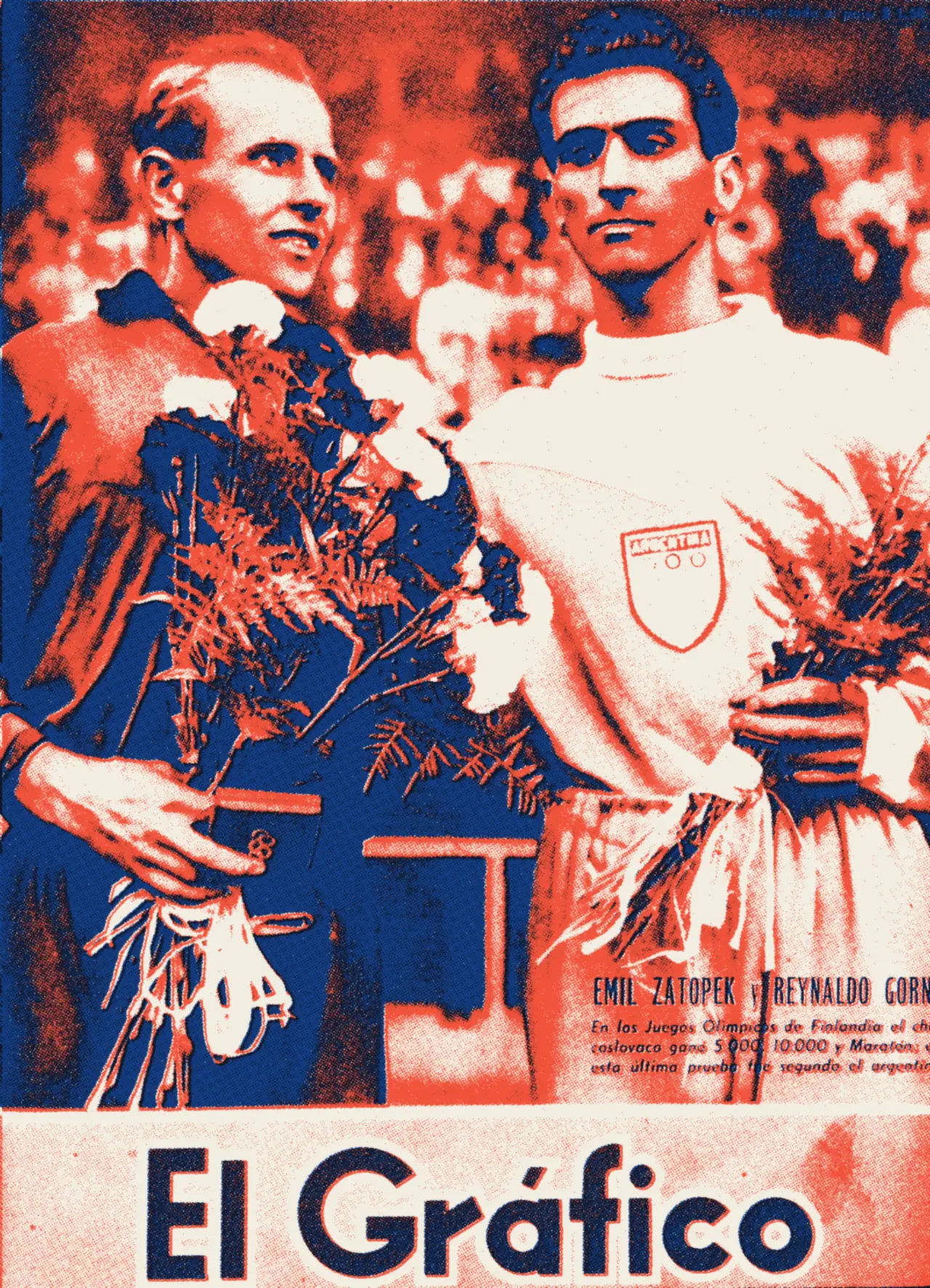
Zátopek, Helsinki 1952: 5,000 m, 10,000 m, Then a First Marathon
How did Emil Zátopek win the Olympic marathon on his first try? Helsinki, July 1952: he has already won the 10,000 m and the 5,000 m. Then he lines up for a marathon, a distance he has never run. He wins that too. In between, his wife Dana became an Olympic champion, on the very day of his 5,000 m.