Zátopek, Helsinki 1952: 5,000 m, 10,000 m, Then a First Marathon
How did Emil Zátopek win the Olympic marathon on his first try? Helsinki, July 1952: he has already won the 10,000 m and the 5,000 m. Then he lines up for a marathon, a distance he has never run. He wins that too. In between, his wife Dana became an Olympic champion, on the very day of his 5,000 m.
By the PacePoster desk · · 3 min · 16 sources
01Eight days, three events
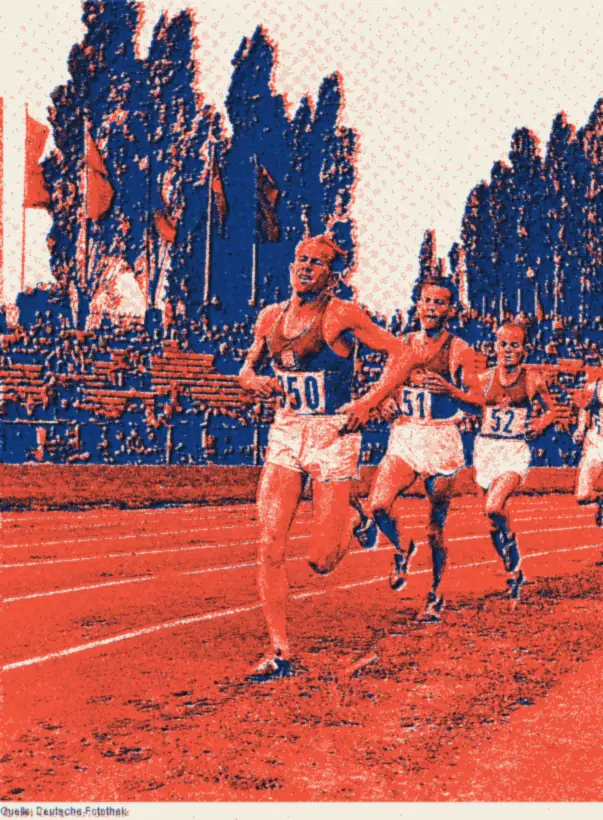
On July 20, Zátopek defends his Olympic 10,000 m title and keeps it with an Olympic record, 29:17.0. On the 24th, in the 5,000 m, he is fourth at the start of the last lap; he passes everybody, while Britain’s Christopher Chataway falls after catching the edge of the track. He wins in 14:06.6, another Olympic record. Three days later, on the 27th, he lines up for the marathon. In 8 days: 3 events, 3 titles. Olympedia calls this treble unique in Olympic history.
02Dana, the same day
On July 24, the 5,000 m is not the only event. Dana Zátopková, his wife, born the same day as him, September 19, 1922, wins the javelin. With her very first throw, and an Olympic record. Their story began with a javelin, in fact: according to the Associated Press, he courted her in England, before the 1948 Games, by playing catch with a javelin. Richard Benyo tells it in Marathon & Beyond magazine: he had lent her his gold medal as a good-luck charm. Two Olympic titles in the same household, on the same day.
Pace too slow
03A marathon never run
Zátopek has never run a marathon. The favorite is Jim Peters: in June 1952, the Briton broke the world record in 2:20:42. Peters goes out fast, very fast. He passes 10 km in a little under 32 minutes. Zátopek stays behind.
04The Zátopek marathon bluff: “Pace too slow”
Zátopek and Sweden’s Gustaf Jansson eventually catch him. Peters told what followed in his autobiography, quoted by World Athletics. Two or three miles side by side, without a word. Then, shortly before the turnaround, Zátopek speaks: “The pace? Is it good enough?” Peters is almost spent, but does not want to show it: “Pace too slow.” Zátopek insists: “You say too slow. Are you sure the pace is too slow?” Peters says yes. Zátopek shrugs and, a few moments later, speeds up with Jansson. AIMS reports a shorter version: “Jim — the pace — is it ok?” — “too slow.” Peters never comes back: cramping, he drops out. The bluff did not hold.
05The tape that saves him
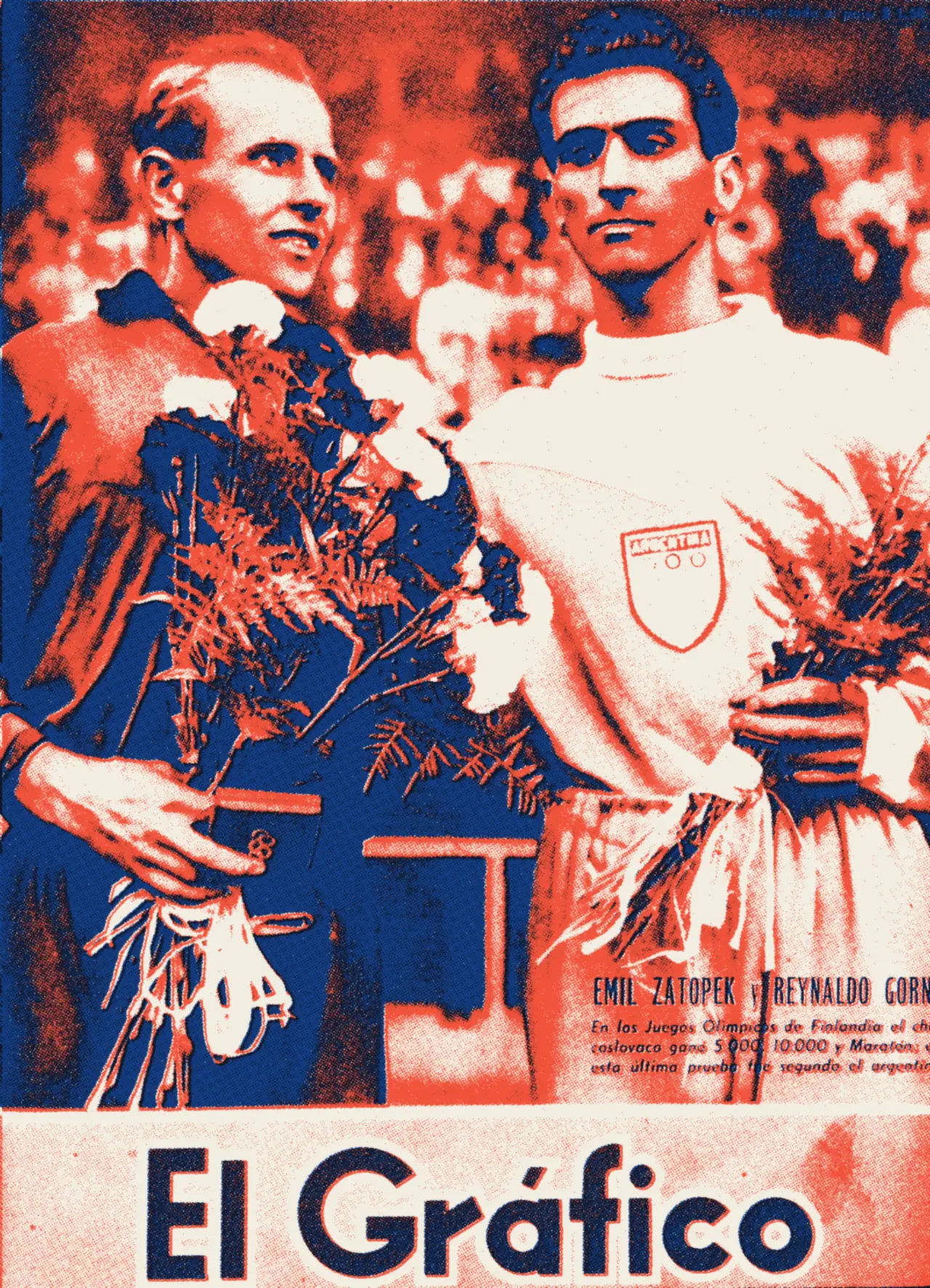
Zátopek wins in 2:23:03.2, an Olympic record. Argentina’s Reinaldo Gorno is second in 2:25:35, more than two and a half minutes behind. After the race, Zátopek described the moment in English, Radio Prague International reports: “I was frightened that I would collapse or something.” Without eating or drinking, he said, he ran to the stadium, and “only the tape saved me from collapsing.”
Sources for this story (16)
Every fact was cross-checked in at least two independent sources. Where they disagree, the story says so.
- Marathon, Men, 1952 Summer Olympics — Olympedia
- 10,000 metres, Men, 1952 — Olympedia
- 5,000 metres, Men, 1952 — Olympedia
- Javelin Throw, Women, 1952 — Olympedia
- Emil Zátopek — Olympedia
- Dana Zátopková — Olympedia
- Emil Zátopek: Olympic treble, Helsinki 1952 — World Athletics Heritage (Simon Turnbull, 2022)
- Reinaldo Gorno — World Athletics
- Jim Peters — AIMS
- Emil Zátopek: a Czech sporting hero — Radio Prague International (David Vaughan, 2008)
- AP Was There: 1952 Helsinki Games — Associated Press, via Yahoo Sports
- In Emil's Footprints — Marathon Handbook (Richard Benyo, Marathon & Beyond, 2012)
- The Olympic Marathon through iconic photographs — Musée olympique / Google Arts & Culture
- API Wikimedia Commons — photos du brouillon
- API Wikimedia Commons — photos de 1952 candidates
- API Wikimedia Commons — photos Deutsche Fotothek
Read next
The whole journal → No. 42
Why Is the Boston Marathon on a Monday? 1775, 1897 and 1969
Why is Boston Marathon on Monday? Because it is run on Patriots' Day, the holiday that recalls the first battles of the American Revolutionary War, on April 19, 1775. It all got locked in during 1969, when this Massachusetts holiday became the third Monday of April.
 No. 43
The World's Oldest Marathon Runner? Fauja Singh, 100 Years Old in Toronto
The oldest marathon runner in the world, according to the AP, is Fauja Singh. On October 16, 2011, in Toronto, he finished a marathon at 100 years old, going by his passport. Yet Guinness never validated his record: it lacks a birth certificate, and nobody can provide one.